
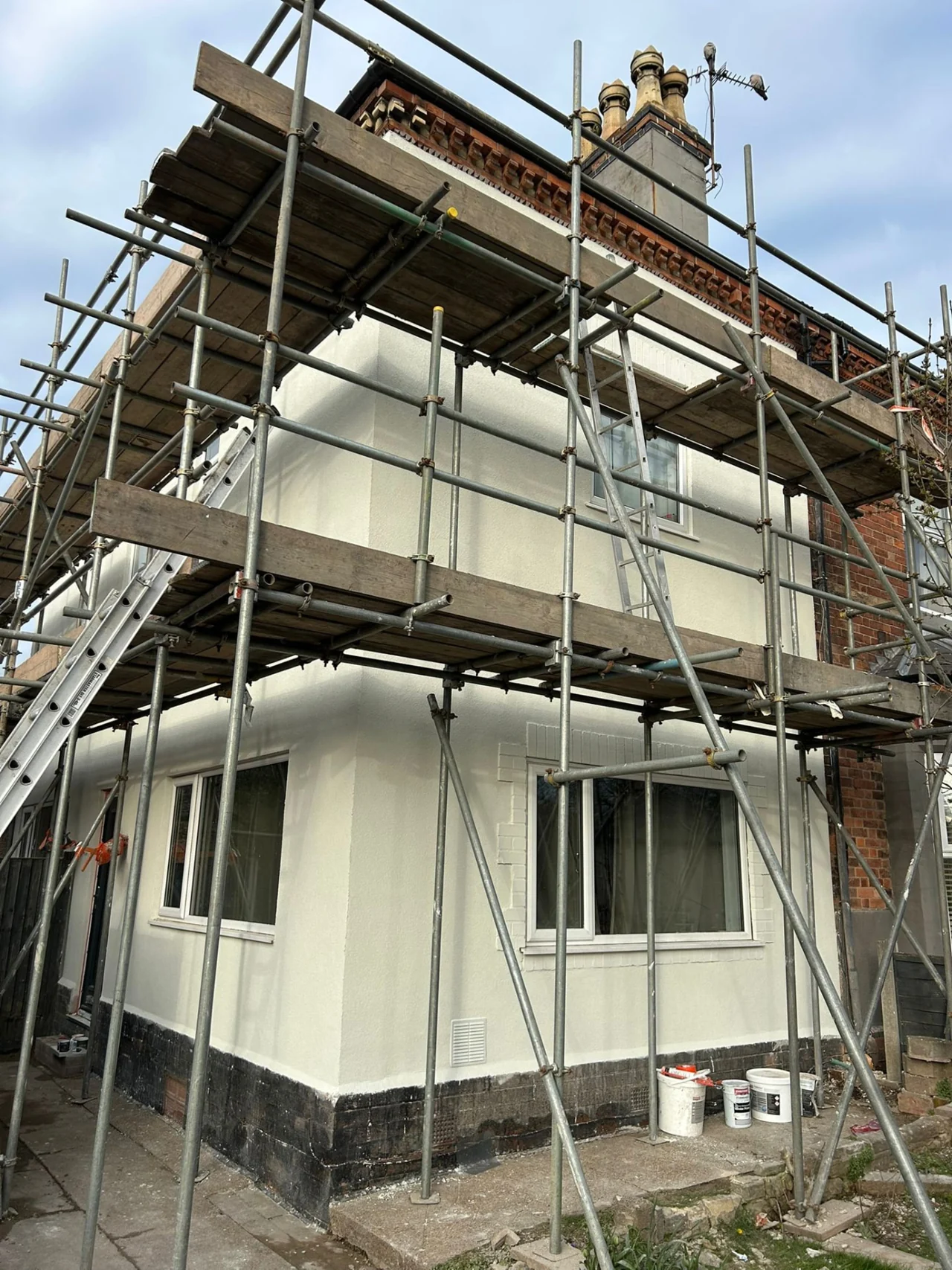
House Renderingin NottinghamProtect and Transform
A properly applied external render that protects your walls from the weather and gives your home a clean, fresh finish, applied by experienced trades.
- 5 years trading
- Trades with 10–30 years’ experience
- Free site visit & written quote
- Gas Safe & NICEIC/NAPIT trades
Service overview
Rendering explained
What it is
Rendering is the application of an external coating to the outside walls of a building. It protects brick and blockwork from rain and frost and gives the property a uniform, finished appearance. Render systems vary, from traditional sand and cement to modern through-coloured and silicone-based systems.
Who it’s for
Rendering suits homeowners whose brickwork is weathered, patched or mismatched after extensions, people wanting to modernise how their house looks from the street, and properties where old render is cracked, blown or stained. It’s often included as part of a full home renovation.
When you need it
Common signs you need rendering or re-rendering are cracked or hollow-sounding existing render, damp patches on internal walls, crumbling or spalling brickwork, or an extension that doesn’t match the original house. It’s best carried out in suitable weather conditions, which we’ll plan around.
Why professional help matters
Render only protects your walls if it’s applied correctly. Poor preparation, the wrong system for the substrate or bad detailing around windows and at ground level can trap moisture and cause the render to crack and blow. Our contractors each bring between 10 and 30 years of experience in their trade.
The cost of waiting
What happens if it’s left
Cracked render lets water behind it. Once moisture gets in, frost forces the render away from the wall, the cracks spread and damp can reach the inside of your home. Unprotected, weathered brickwork can deteriorate in the same way.
Leaving failing render means a bigger area to strip and redo later, and possible internal damp repairs and redecoration. Patching small areas often leaves visible repairs that don’t match.
Common mistakes we put right
- Rendering over loose or failing render without stripping it first.
- Choosing a system that isn’t suited to the wall it’s going on.
- Poor detailing at window reveals, sills and ground level.
- Applying render in unsuitable weather.
- Ignoring the cause of damp before rendering over it.
Our process
How your rendering job runs
- Step 1
Free site visit
We inspect the walls, existing render and any signs of damp or damage.
- Step 2
Written quotation
A clear quote setting out preparation, the render system and the areas covered.
- Step 3
Preparation
Loose material removed, surfaces cleaned and prepared, and surroundings protected.
- Step 4
Application
The render system applied in coats, with attention to corners, reveals and edges.
- Step 5
Finish & clean
Final finish checked and the site cleared.
What you get
Why choose VTR for rendering
Weather protection
A sound external coat that helps keep rain and frost out of your walls.
Kerb appeal
A clean, uniform finish that refreshes how your home looks.
Hides mismatches
Makes extensions and patched brickwork look like one building.
Experienced trades
Contractors with 10–30 years’ experience in their trade.
Joined-up work
Combine with roofing or a full renovation under one team.
Free quote
A free site visit and written quotation first.
In detail
Types of rendering we carry out
Sand and cement render
A traditional render applied in coats and usually painted. Suitable for many masonry walls and a familiar finish on British homes.
Modern render systems
Through-coloured and silicone-based systems are designed to resist staining and reduce the need for repainting. Which system suits your property depends on the wall and the finish you want, which we discuss at the site visit.
Re-rendering failed walls
Where existing render is cracked or blown, it usually needs to be removed back to sound material before new render is applied. Rendering over failing render just transfers the problem.
Extensions and mixed brickwork
Rendering is a common way to tie an extension visually into the original house when bricks don’t match.
Part of a wider project
Rendering is often combined with roofing repairs or a full renovation, so the outside of the property is as sound as the inside.
Planning guide
What to know before you start
What happens before render goes on
The quality of a render finish depends on what’s under it. Walls are checked for loose material, previous failed render, cracks and damp. Old coatings that are no longer bonded are removed, and the surface is cleaned and prepared so the new render can grip. Details such as beads at corners and edges, and the junctions around windows, doors and sills, are formed carefully because these are the places where water most often gets behind a poorly applied render.
Render and damp
Damp inside a property isn’t always caused by the walls. It can come from leaking gutters, failed pointing, high ground levels against the wall, or condensation inside. Rendering over a wall without understanding where moisture is coming from can trap it in the masonry. At the site visit we look at the whole picture, including roofing and rainwater goods, so the render is part of a proper fix rather than a cover-up.
Combining rendering with other external work
External projects are often more efficient when they’re combined. If access is being arranged for rendering, it can also be used for roofing repairs, fascias or external decorating. Within a VTR project, those trades are coordinated so the outside of your home is completed in one planned piece of work rather than several separate visits.
Weather and timing
Render needs the right conditions to cure properly. Heavy rain, frost and strong direct sun can all affect the finish and its durability. We plan rendering around the weather instead of forcing it through, which can mean adjusting dates. It’s a small inconvenience compared with a render that cracks or fails early because it was applied in the wrong conditions.
Looking after rendered walls
A well-applied render needs little maintenance, but it pays to keep an eye on it. Check for cracks after a hard winter, keep gutters and downpipes clear so water isn’t running down the face of the wall, and make sure soil and paving aren’t built up against the base. Catching small issues early keeps repairs small.
Rendering for extensions and mixed brickwork
When a house has been extended over the years, the brickwork rarely matches perfectly. Different bricks, mortar colours and pointing styles make an extension look added-on. Rendering the whole elevation, or the whole property, ties the building together visually so it reads as one home. It can also cover old repairs, patched brickwork and blocked-up openings that would otherwise always be visible.
Rendering within a full renovation
If you’re renovating a property inside, it often makes sense to deal with the outside at the same time. Damp walls, failing render or weathered brickwork can undermine the internal work you’re paying for. Bringing rendering into the same VTR project means one team plans the inside and outside together, and the property is finished as a whole.
What to expect on the day
Rendering is a staged process. Preparation and protection come first, then the base coats, then the finish. Each coat needs time before the next goes on, so the work is spread over several days rather than done in one visit. We keep the area around your home tidy and clear materials at the end of the job.
Questions
Rendering FAQs
Related services
How much does house rendering cost in Nottingham?+
Every property is different, so we don’t publish fixed prices. We visit free of charge, assess the job and give you a written quotation so you know the scope before any work starts.
How long does rendering a house take?+
It depends on the size of the property, the condition of the walls and the weather. We’ll give you a timescale with your quote.
Can you render in winter?+
Render needs suitable conditions to cure properly. We plan the work around the weather rather than rushing it.
Do I need to remove old render first?+
If the existing render is cracked, hollow or loose, it usually needs removing. We’ll check at the site visit.
Will rendering stop damp?+
Render protects walls from the weather, but damp can have other causes. We look at the cause at the site visit before recommending rendering.
Is rendering guaranteed?+
Renovation projects come with a 3-month workmanship guarantee. Ask us how this applies to your rendering job.
Do you render houses in Mansfield and Hucknall?+
Yes. We cover Nottingham, Derby, Mansfield, Sheffield, Loughborough and towns including Hucknall and Arnold.
Is rendering an emergency service?+
We are not a 24-hour emergency call-out service. Ring us during opening hours and we’ll tell you honestly how quickly we can attend and what can be done in the meantime.
Get your renderingdone properly, once.
Free site visit, written quotation, and one team handling every trade. No obligation.